ASU leaders explore AI, access and the future of learning at the 2026 ASU+GSV Summit
Powered by new pathways, credentials and technology, attendees chart the reshaping of education and work
More than 7,000 education and workforce leaders from 65 countries gathered in San Diego this week for the 2026 ASU+GSV Summit, where conversations focused on the impact of artificial intelligence, new credential models and expanded access on the future of education.
Hosted by Arizona State University and Global Silicon Valley, the event featured over 50 ASU speakers highlighting the university’s future-focused learning initiatives.
With a focus on leading the way in a changing world, speakers discussed how traditional pathways to education and employment are being redefined.
Beyond the degree: Lifelong learning as the future of education
Universities have reached a tipping point, with artificial intelligence accelerating a shift to skills-based, workforce-aligned learning.
Kristin Lord, Vice President of Global Strategy and Engagement at ASU, moderated “The AI Talent Development Engine: Who Builds the Future Workforce,” where panelists examined the transition happening across institutions of higher education.
“What does it mean to be a university in a world where learning never stops?” asked panelist Marco Serrato, vice president of ASU’s Learning Enterprise. To Serrato, the answer lies in universities providing continuous, lifelong learning through a reimagined educational architecture.
This week, ASU launched ASU for Life, an AI-enabled platform bringing together learning experiences from across the university into connected pathways. The platform helps learners understand how to build relevant skills and how each step contributes to longer-term career mobility.
ASU for Life represents ASU’s redefined vision of what a university is: a service that supports learners across their lifetime, beyond a one-time degree.
We’re at a crossroads with artificial intelligence
How will the advent of artificial intelligence reshape human potential and talent?
This question drove “The Global AI Shift: Rewiring Learning and Work,” where moderator Patrick Rossol-Allison, associate vice president of ASU’s Learning Enterprise, and panelists explored differing viewpoints surrounding AI’s impact on the redistribution of power and the redesigning of learning.
Panelist Candace Thille of Stanford University’s Graduate School of Education emphasized the importance of intentional AI design. She noted that AI can either concentrate power within elite institutions or expand equitable access to education globally. The outcome depends on the choices we make as AI designers and builders.
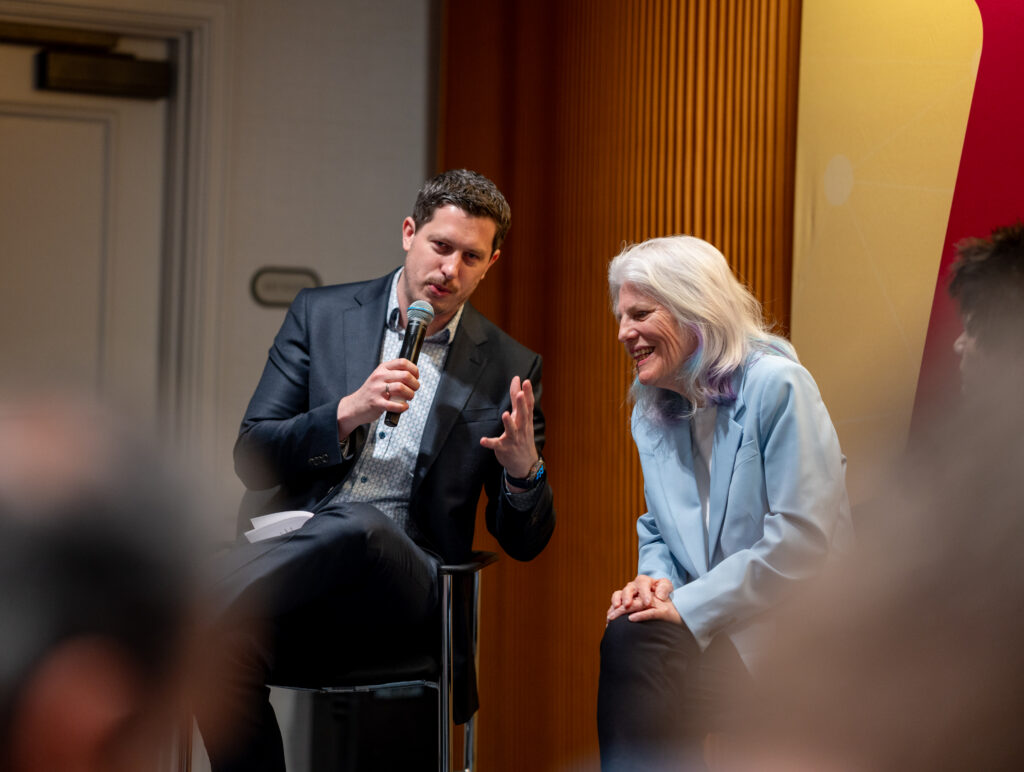
Moderator Patrick Rossol-Allison speaks with Candance Thille.
On the workforce front, AI is disrupting traditional early career roles. With junior support roles replaced by automation, mid-career professionals are navigating the ethical and practical realities of AI as a new “co-worker,” including the risk of the technology reinforcing bias.
“You almost have to realize that how you do your job today is not how you’re going to do it tomorrow,” says panelist Miki Edelman of Macquarie Group.
Going forward, effective AI adoption will require reimagining workflows, job roles and pathways to early career development.
Access means more than just opening the door
Hundreds of innovative K-12 schools across the country have partnered with ASU to offer college-level courses to high school students, expanding early access to higher education.
Scott Weatherford, associate vice president of Universal Pathways and K-12 Learning Solutions at ASU’s Learning Enterprise, moderated “No Barriers, No Limits: How ASU and K-12 Schools Are Rewriting the College Playbook” with school leaders from across the country, exploring how these partnerships are changing expectations for college access.
Accelerate ASU, one of the nation’s largest university dual enrollment providers, removes typical enrollment barriers including cost, GPA requirements and rigid schedules. By offering affordable courses that students can work through at their own pace, ASU is creating a new system that prioritizes access.
Panelist Paul Escala of the Archdiocese of Los Angeles discussed the positive impact of ASU’s model, especially for first-generation and underserved students.
“Putting a student in the position to believe in themselves enough to challenge the status quo has been one of the greatest upsides of this [program],” he says.

Moderator Scott Weatherford and panelist Paul Escala listen as Kristy Lundstrom speaks.
Access to college-level work is not just a structural issue. It requires helping students overcome limiting cultural and psychological beliefs to see themselves as college material.
Taking a break doesn’t mean the end of the road
Around 44 million Americans have started college but not earned a degree.
ASU sees this as a solvable problem, which university leaders demonstrated in an invite-only panel called “Operation Comeback.”
Through initiatives like Earned Admission, ASU has built a human-centered reentry model that removes typical barriers. As an affordable, flexible program that helps students navigate their return amongst competing life demands, Earned Admission has brought back over 22,000 students, nearly 5,000 of whom have since graduated.
Along the way, ASU has resolved over one million dollars in student balances.
ASU hopes to scale this model nationally through strategic partnerships and philanthropic investments — all with the goal of changing lives, strengthening communities and providing second chances.
Proving capability through scalable, real-world experience
Young people entering the workforce today face a paradox, finding that entry-level jobs require prior work experience. The problem is only growing as artificial intelligence replaces an increasing number of junior roles.
Nadia Viswanath, Chief Growth & Operations Officer at ASU’s Learning Enterprise, moderated “Beyond the Degree: How ASU is Building a Credentialing Framework for a New Economy,” an exploration of the importance of embedding experiential learning directly into education.

By providing learners with real-world experience, and the credentials to prove their workforce-ready skills, universities can offer students a boost in an uncertain world of work.
ASU is tackling this challenge through its flexible learning pathways, with stackable credentials that learners can translate into degrees and professional certificates. While degrees provide vital foundational knowledge, the future of education lies in providing learners with the skills and competencies needed to put their knowledge into action.
Shaping the future of learning
Summit discussions shared a common vision for the future of learning, where education is aligned with evolving workforce demands and accessible to learners at every stage of life. Through its expanding portfolio of programs that support learners across entry, progression and reentry, ASU continues to play a central role in shaping that future.
Marco Serrato, Vice President of ASU’s Learning Enterprise, believes that innovation allows ASU to be at the forefront of this transformation.
“At ASU, we’re redesigning lifelong learning systems to meet the demands of a changing world,” says Serrato. “The future of learning isn’t a single moment in time. It’s a continuous journey. We’re building systems that help learners navigate that journey: connecting who they are, what they want to achieve and the skills they need to get there.”