Learning Enterprise showcases how design, data and AI support learners at scale at ASU’S annual FOLC Fest
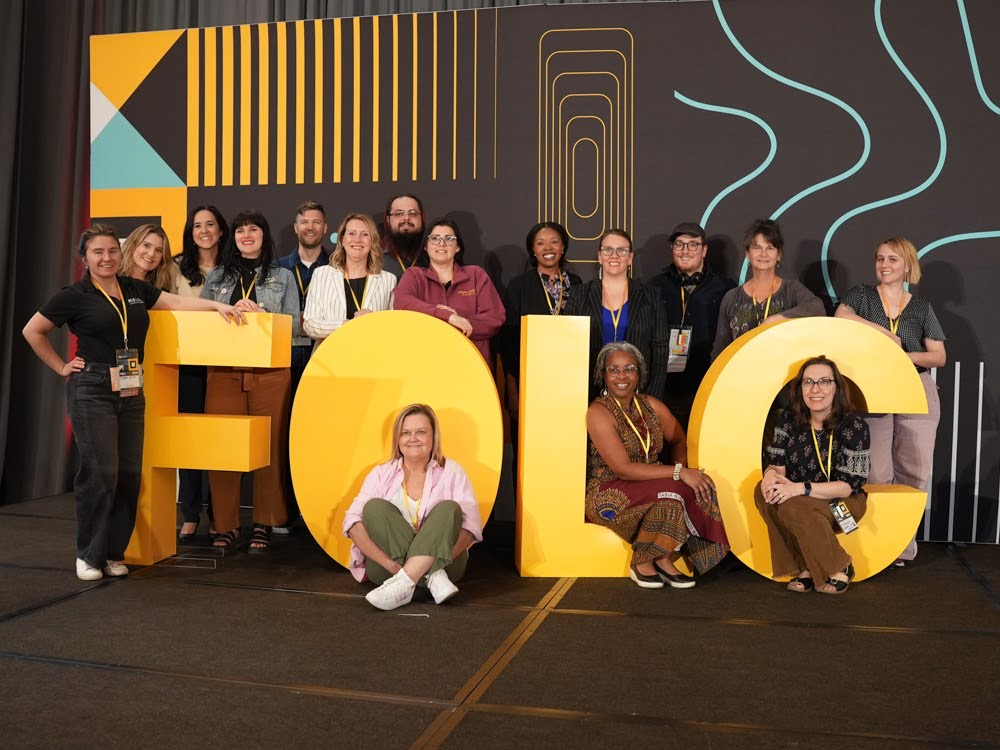
Presentations and demos highlighted staff contributions that help extend faculty expertise to learners across pathways and life stages.
How do design choices made behind the scenes shape learners’ ability to engage, persist and succeed?
At this year’s Future of Learning Community Fest, or FOLC Fest, the ASU Learning Enterprise team played a significant role in sharing how Arizona State University is applying learning design, data-informed decision-making and thoughtful uses of artificial intelligence to support learners across a wide range of goals, backgrounds and life stages.
Across talks, posters and interactive demos, staff highlighted work developed in close collaboration with ASU’s schools and colleges — translating faculty expertise into learning experiences that reach learners earlier, more flexibly and at greater scale and impact, in support of the university’s Changing Futures priorities.
“I’m proud of how our teams contributed to FOLC Fest,” said Scott Weatherford, associate vice president of Universal Pathways and K-12 Learning Solutions. “This work shows how ASU brings together faculty expertise, learning design and AI to expand access and improve outcomes for learners at very different moments in their lives.”
Organized by the ASU Academic Enterprise in the Office of the University Provost, FOLC Fest brings together faculty, staff and learning professionals from across the university to share work already underway and connect it to ASU’s mission to expand opportunity and impact at scale.
Designing learning for engagement and persistence
Several Learning Enterprise poster presentations focused on how instructional design choices influence learner engagement and persistence, particularly in online and open-access environments serving learners with varied schedules and responsibilities.
Bobbi Doherty, senior online course manager, presented research examining how instructor modeling videos can strengthen teaching presence and sustain learner commitment over time. While overall pass rates remained stable, her findings showed that increased instructor presence helped reduce late-course performance decline, signaling stronger persistence among learners.
Instructional designer Marissa Huth shared lessons learned from integrating the generative AI tool Claude into Canvas-based instructional design workflows. Her poster emphasized practical use cases, common pitfalls and mindset shifts that help designers work more effectively with AI while maintaining clarity, quality and care in course production.
Another poster, presented by Nicholas Rogers (online course manager) and Alejandra Dashe in collaboration with College of Health Solutions faculty member Teri Taylor, highlighted the redesign of an online undergraduate health and wellness course. Grounded in Backward Design and Universal Design for Learning, the project demonstrated how aligning learning objectives, assessments and AI-supported tools can improve accessibility, engagement and learner success across diverse student populations.
Turning course data into actionable design
In a featured talk, Lenora Ott, senior director of learning design, shared how course-level analytics can inform instructional design decisions earlier and more intentionally.
“When our team first started this work, it was new for most of us,” said Ott. “By building a community of practice, that uncertainty turned into curiosity — and now data-informed design is a normal, less intimidating part of how we work.”
Her session, Designing with Data: Turning Course Analytics into Actionable Learning Design, focused on moving beyond surface-level metrics to identify patterns in learner engagement and performance. By examining data across key course touchpoints, Ott showed how designers and faculty can pinpoint where learners struggle and refine course structures to better support diverse learner needs.
Interactive demos extended that focus on applied analytics. Pallavi Sharma, manager of analytics, presented the ABCD AnyBody Can Dashboard through a live demonstration of Google Looker Studio, highlighting how the self-serve tool can integrate multiple data sources to help teams visualize program success.
“My goal was to help colleagues see that they already have access to tools that make data easier to use,” Sharma said. “Because Looker is free for ASU students, faculty and staff and easy to use, it encourages a more data-informed approach without the barrier of learning complex visualization tools.”
Learning success designer Rachel Reed and data analyst Vanshaj Gupta showcased The Ecology of Learning Data, mapping how learner data flows from the classroom to leadership decision-making.
“New programs tend to be more vulnerable during the first year,” Reed said. “When decision-makers can see what’s happening with different learner populations at a glance, it becomes easier to surface issues early and respond in meaningful ways.”
Advancing accessibility through applied AI
Several Learning Enterprise demos focused on accessibility and the applied use of AI to reduce friction for both learners and educators.
Rogers and Jaclyn Campbell (instructional designer) demonstrated Access Granted, which uses Claude AI to support WCAG compliance in digital course materials. Dashe, Bianca Zietal (instructional innovation specialist), Yash Pachchigar (AI innovation specialist) and Divyansh Chandarana (learning innovations research analyst) presented benchmarking work on AI transcription accuracy in STEM courses, emphasizing how precision with numbers, formulas and symbols is critical for accessibility and trust.
Dashe, Rogers and Campbell also introduced The PDF Remediator, an AI-supported tool in the prototype stages that is designed to streamline the creation of accessible course materials and integrate inclusive design into everyday instructional workflows, rather than treating accessibility as a separate or downstream task.
Learning across life stages
Across FOLC Fest, a clear throughline emerged: learning systems need to adapt to learners’ lives, not the other way around. The sessions highlighted how faculty and staff across ASU are using design, data and carefully applied AI to reduce barriers, surface insight and support learners earlier and more flexibly.
“This is how Changing Futures becomes real work,” Serrato said. “It’s about building learning systems that can respond as learners’ lives and goals change — and doing that work in partnership across the university.”
Learning Enterprise presentations at FOLC Fest
Thank you to all those from the LE staff who presented:
Talks
• Designing with Data: Turning Course Analytics into Actionable Learning Design — Lenora Ott
• Changing Futures: Expanding College Access for High School Students Through ASU Innovation — Sarah Bixler
Expo / Demos
• ABCD AnyBody Can Dashboard: Building Self-Serve Looker Dashboards — Pallavi Sharma
• Access Granted: Using Claude AI for WCAG Compliance — Nicholas Rogers, Jaclyn Campbell
• Beyond Words: Benchmarking AI for Accessible Learning — Bianca Zietal, Alejandra Dashe, Yash Pachchigar, Divyansh Chandarana
• The Ecology of Learning Data: Mapping the Flow from Learner to Leader — Rachel Reed, Vanshaj Gupta
• The PDF Remediator: Claude to the Accessibility Rescue — Alejandra Dashe, Nicholas Rogers, Jaclyn Campbell
Posters
• Bringing the Instructor to Life: How Modeling Videos Boost Connection and Learning Online — Bobbi Doherty
• Lessons Learned from Claude ’n’ Canvas — Marissa Huth
• Transforming an Online Health and Wellness Course Through Evidence-Based Design — Nicholas Rogers, Alejandra Dashe, Teri Taylor (College of Health Solutions)
Explore our photo gallery below, then check out our coverage of FOLC Fest in ASU News!


Photos by Cari Frederick, Aaron Ghena and Shlok Patel